When the Best Engineers Never Apply Anywhere
Sourcing from public work and clear reasons to move reaches engineers who never apply.

Invitation-style recruiting finds engineers through their work and reputation, then initiates hiring by bringing them specific jobs. The best engineers often never apply because the work they do already brings employers to them. Reaching this tier takes evidence-based sourcing, a clear reason to move, and a hiring process fast enough to respect someone who already has a good job.
Why the best engineers are already off the market
An application pool is not a cross-section of engineering talent. Only a small minority of developers are actively looking at any given time, while the overwhelming majority are not searching. Strong engineers often have jobs where they do well and spend their time on problems worth solving. Employers want to hire them for that work before they even think of leaving. By the time a company opens a role, many of the people it would most like to hire have no reason to visit its careers page.
That is a lasting feature of successful technical careers. An engineer builds something difficult, earns a reputation, and starts receiving interesting approaches without initiating a search. The work itself becomes the introduction. This does not mean that everyone who applies is weaker, or that every employed engineer is exceptional. It means that a company relying only on applications is selecting for willingness to search as well as ability to do the job.
Inbound applications still serve a useful purpose. They bring companies people who have already decided to consider a change, removing the need to establish that initial interest. But they cannot bring in engineers who would welcome a specific job while paying no attention to the broader job market. A hiring team can improve its application process and still never reach that group.
What keeps strong engineers from applying even when they are open to a move
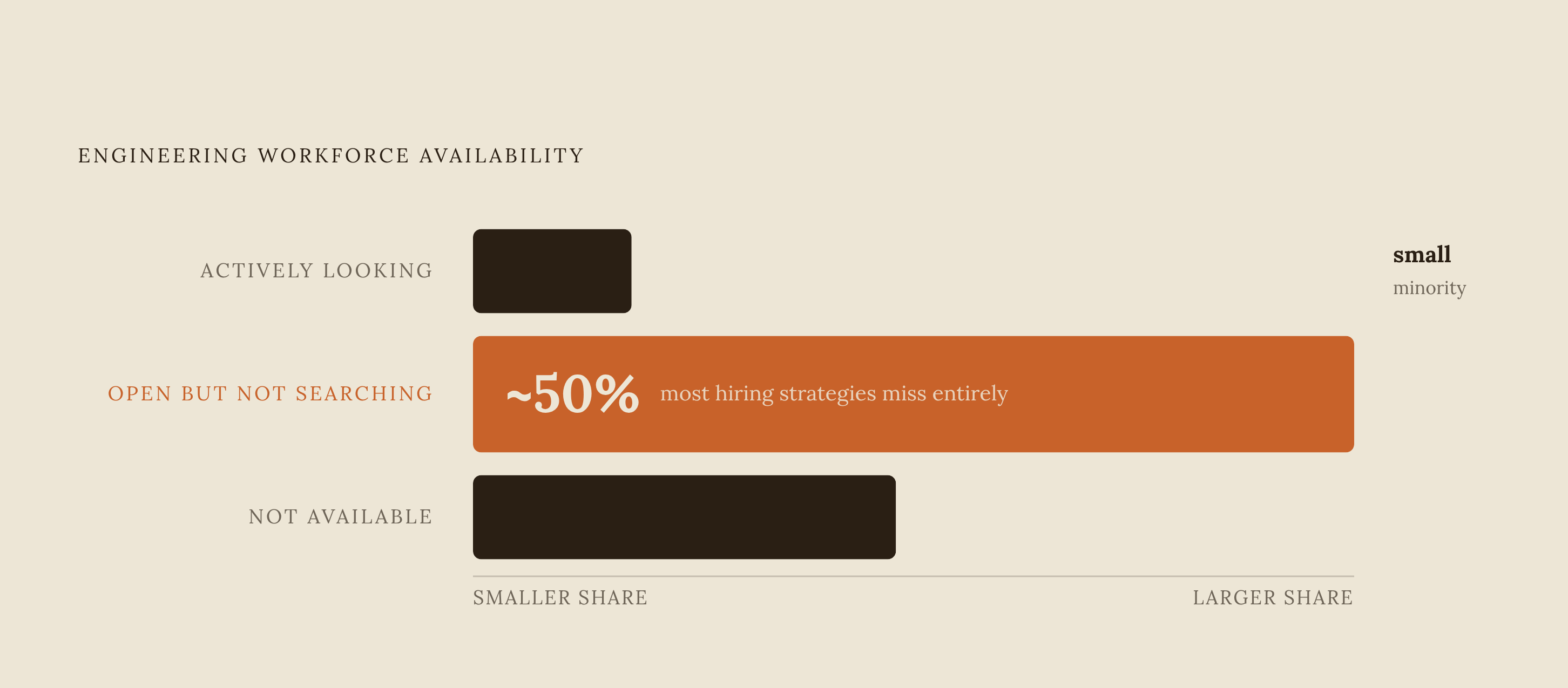
There are three different groups behind the loose label of “available talent.” Some engineers are actively looking, some are open but not searching, and some are not available at all. The middle group is the important distinction. Roughly half the engineering workforce falls into that category, employed and generally satisfied but willing to consider a compelling opportunity that finds them. Treating them as unavailable misses the opening, while treating them as applicants misunderstands what they need.
For someone with a good job, applying creates work before it establishes value. Multi-step forms and redundant information requests demand time, automated screens can filter out qualified people, and silence after submission leaves the outcome uncertain. The upside is still only a possibility. An active job seeker has a reason to tolerate that friction, but a comfortable engineer can simply return to the work already in front of them. Passivity is often a rational response to that trade-off.
The costs extend beyond the application itself. A move means learning a new codebase, resetting relationships, weighing equity losses, and accepting the risk that the new role will disappoint. An engineer can be interested without being ready to undertake an open-ended hiring process. Companies waiting for an application will not learn what would turn that interest into a decision.
Why AI and ML roles have made the passive-candidate problem structurally worse
AI and ML sharpen this mismatch because their engineers are among the most passive candidates while senior demand outpaces supply. Companies that want engineers with production AI experience are competing with both startups and large technology firms for the same shortlist. A company can face urgent demand for a skill without finding many people with that skill willing to start a search.
Titles make the shortage harder to navigate. AI Engineer roles outnumber Research Scientist roles on job boards, but the two call for different evidence of ability. The former cluster around production tooling, including RAG, APIs, and cloud skills, while the latter emphasize deep learning, reinforcement learning, algorithms, and a publication record. Searching for the wrong title can therefore miss the right person or produce candidates suited to a different job. More outreach does not correct that mismatch.
Inside frontier labs, there is often more demand for a Research Engineer than a Research Scientist because running experiments at scale is itself a bottleneck. Some frontier organizations also post their most senior model-training roles under titles such as “Member of Technical Staff,” which contain none of the obvious search terms. Titles alone are a poor routing system. At the same time, the share of ML companies explicitly listing remote positions has dropped sharply, with in-person or hybrid work becoming the norm at most organizations. That removes one of the levers employers previously used to make a conversation attractive.
What actually moves a passive engineer to take a conversation
Henderson Scott's 2026 Technology & Data Hiring Snapshot says that chances to grow, better leaders, interesting technical work, and a business that is stable over the long term can move engineers who are not looking as much as pay can. Money still establishes the threshold for a move. Passive engineers usually want a package worth enough more than what they now get to make the risk worth taking. Once that threshold is met, however, the work and the team give one opportunity an advantage over another.
For an engineer receiving an approach, the useful question is whether the sender understands the work behind the profile. Strong candidates already get messages often, so a message alone proves little. A message that fits the engineer links something they have actually done to the problem the company needs solved. That connection also reveals that the engineer is being evaluated on demonstrated ability. A template that could have gone to hundreds of people offers no such evidence.
For founding engineer and early-stage roles, the choice goes beyond what the engineer will work on next. Equity, how well the leaders lead, and their product vision help an engineer decide whether the company is worth betting on. The engineer is choosing a direction as well as a package. Henderson Scott's August 2026 Hiring Snapshot describes the successful approach in terms of explaining why the role matters, how the team is growing, and what impact the individual can make.
Where passive engineers leave signals that good sourcing can find
Engineers who never apply can still leave substantial evidence of their ability in public. Open-source projects, community forums, technical meetups, and smaller conferences put their work and expertise where other people can evaluate them. These are not primarily places for submitting credentials.
The difficult case is the “underrated” developer whose contribution quality is high but whose social visibility is low. That person may have few GitHub followers, no popular repositories of their own, and no presence on social media, while quietly shipping strong work to important repositories. Popularity is not the same as technical evidence. Recruiters who use follower counts as their main filter can miss exactly the people a contribution-led search is meant to uncover.
GitHub's official Call for Sessions page says GitHub Universe 2026 will be held on October 28–29 at Fort Mason Center in San Francisco. HackerX says its recruiting events are invite-only and that it holds them in cities that include San Francisco, Berlin, and London. These are different settings for meeting technical people. Showing up at an event or being part of a community does not by itself prove what someone can do, but either can lead a recruiter to work they can evaluate.
What passive sourcing actually requires — and where it breaks down
Cold outreach has a genuine advantage over waiting for applications because it can reach someone who has not started looking. It does not require prior interest in the employer. Its weakness appears when the message gives a satisfied engineer no specific reason to reply. A small number of well-researched, targeted messages can produce response rates an order of magnitude higher than mass campaigns. Personalization works when it demonstrates relevance.
That approach takes time before a hiring conversation even begins. Someone has to find the contributions, understand their relevance, and make contact in a way that earns attention. Relationship-based sourcing is not an instant shortlist. The preparation that makes it effective can conflict with the speed at which a company needs to close a role.
There is also a serious objection to the claim that passive candidates are inherently better. Recruiters may spend more effort on them, explain opportunities more carefully, and offer richer packages, then attribute the result to candidate quality. That comparison is not clean. Offer quality and recruiter attention may explain part of the apparent advantage, and an active applicant deserves assessment on actual work. An engineer can be between jobs and still be good at their work.
Even so, that objection does not make an application pool representative of the whole market. Active pools include people in legitimate transitions as well as underperformers, while many strong employed engineers remain outside them altogether. Passivity is a sourcing condition. The defensible goal is to reach capable people who would otherwise be absent, then evaluate their contribution. Employers still need that work done without each having to wait for a relationship to be built from scratch.
How do companies hire senior engineers who never look at job boards?
Curated matching separates that preparation from the moment a company needs to hire. In this model, a network develops relationships and evaluates contributions before bringing engineers and employers together. The company enters when a match is already warm. Pre-screening addresses the evidence gap, a specific interview invitation replaces the speculative application, and upfront compensation lets the engineer judge an important condition immediately. This is the practical distinction between invitation-style recruiting and simply sending more cold messages.
Companies should arrive ready to decide, with a clear view of why this engineer fits, what the role offers, and whether the compensation can justify a move. The August snapshot warns that lengthy interview timelines, inconsistent communication, and slow decisions often cost employers candidates who have multiple options. The process itself becomes evidence about the organization. Someone already employed has little reason to keep investing time in a company that cannot explain what happens next.
The median best-candidate window is ten days, so companies need to move fast to compete for hires. A curated network cannot remove every hiring decision, but it can move sourcing and screening ahead of the employer’s first conversation. Fonzi is one example, a curated engineer-to-startup matching network that describes its engineers as screened to select top talent and recommends them to companies for specific interview requests. Its AI talent agent shows salary bids upfront so engineers can weigh the pay before they agree to spend time on interviews.
For engineers, the corresponding lesson is to build a body of work that others can evaluate. Public projects, open-source contributions, and work built outside a day job can show what an engineer can do without a resume having to explain it. In founding engineer and early-stage AI hiring, that proof-of-work can outweigh educational credentials because it shows what someone has actually built. Visibility need not mean a large following. For an engineer who wants to be found rather than apply, the goal is to make strong work visible enough that the right invitation has somewhere to begin.