Selectivity as Infrastructure How a Platform's Rejection Rate Predicts Engineer Quality for AI Startups
A platform's rejection rate means little without work-based vetting.

A curated talent marketplace for elite ML and software engineers joining AI startups should be judged by its filter. Its rejection rate is a leading indicator of engineer quality only when backed by work-based vetting, strong candidate retention, and successful matches. Selectivity helps a startup hire when it screens out people who do not fit the role before the team spends time interviewing them.
Why the standard resume-to-interview funnel fails AI startups before it even starts
AI-assisted resume writing has made polished applications easy to produce, just as inbound volume has grown. A clear, well-targeted resume no longer separates a capable engineer from someone who knows how to present as one. The documents look increasingly alike. For an AI startup, that leaves it unclear whether the applicant can build the system the company needs.
Automated screening compounds the problem because it can reject qualified candidates while passing through unsuitable ones whose resumes match the expected terms. The startup then inherits a pile of profiles that look promising for much the same reasons. More applications give the team more to sort through without making it easier to tell who can do the AI engineering work. When the inbound funnel cannot do that work, the platform a startup hires through becomes a load-bearing decision.
What rejection rate actually measures, and why it is a leading indicator of engineer quality
A platform’s rejection rate is the share of applicants who do not pass its screening process before being presented to a startup. It describes where the filtering happens. A platform that does substantive screening absorbs work that would otherwise fall to the hiring team. Its rejection rate can therefore act as a proxy for vetting quality, provided the reasons for rejection concern the skills the startup needs.
The timing makes it a leading indicator. Before a founder spends an hour interviewing, the platform has already decided which candidates deserve that hour. A human-led, multi-round process can distinguish someone who can spell “LangChain” from someone who has shipped a production RAG system. Resume matching cannot establish that distinction on its own. The value lies in the evidence behind the introduction.
Platform size answers a different question, which is how many people a service can reach or hold in its database. It does not establish how carefully those people are assessed. Brand recognition is no substitute for that evidence either. A large pool with a loose filter can expose a startup to more noise. However, a high rejection rate alone is not proof of rigor, because a narrow or biased screen can reject plenty of people without identifying better engineers.
What vetting rigor actually looks like — and how to tell the difference from theater
A low acceptance rate helps predict whether candidates can do the job only when the process tests the work that job calls for across multiple rounds. The assessment must be calibrated to the role. Rejecting someone because an implementation does not meet the required standard is different from rejecting them because their resume lacks a keyword. Both decisions raise the rejection rate. Only one supplies evidence about whether the person can do that particular job.
What happens to candidates who do not make it through reveals how the platform screens. Does the platform use live coding, a work sample, or an implementation challenge to reach its decision? Does it test AI tool fluency directly? Is a human involved in the final round?
Completion also needs to be separated from rejection. The academic research described by Codility involved a junior frontend role that received tens of thousands of applications and required some applicants to complete an AI interview. Only a quarter of those invited finished it, and more experienced applicants were more likely to quit. A process that loses candidates before testing them may look selective while showing little about what they can do.
The distinction is especially important when resume text remains the main screening input. AI-assisted writing can make strong and weak applicants read alike, so a text-only filter risks measuring the quality of the writing tool. Work samples and human questioning give a platform something to judge beyond the polished profile that created the problem.
Why senior engineers self-select out of loose processes — and how that reshapes what a platform’s acceptance rate means
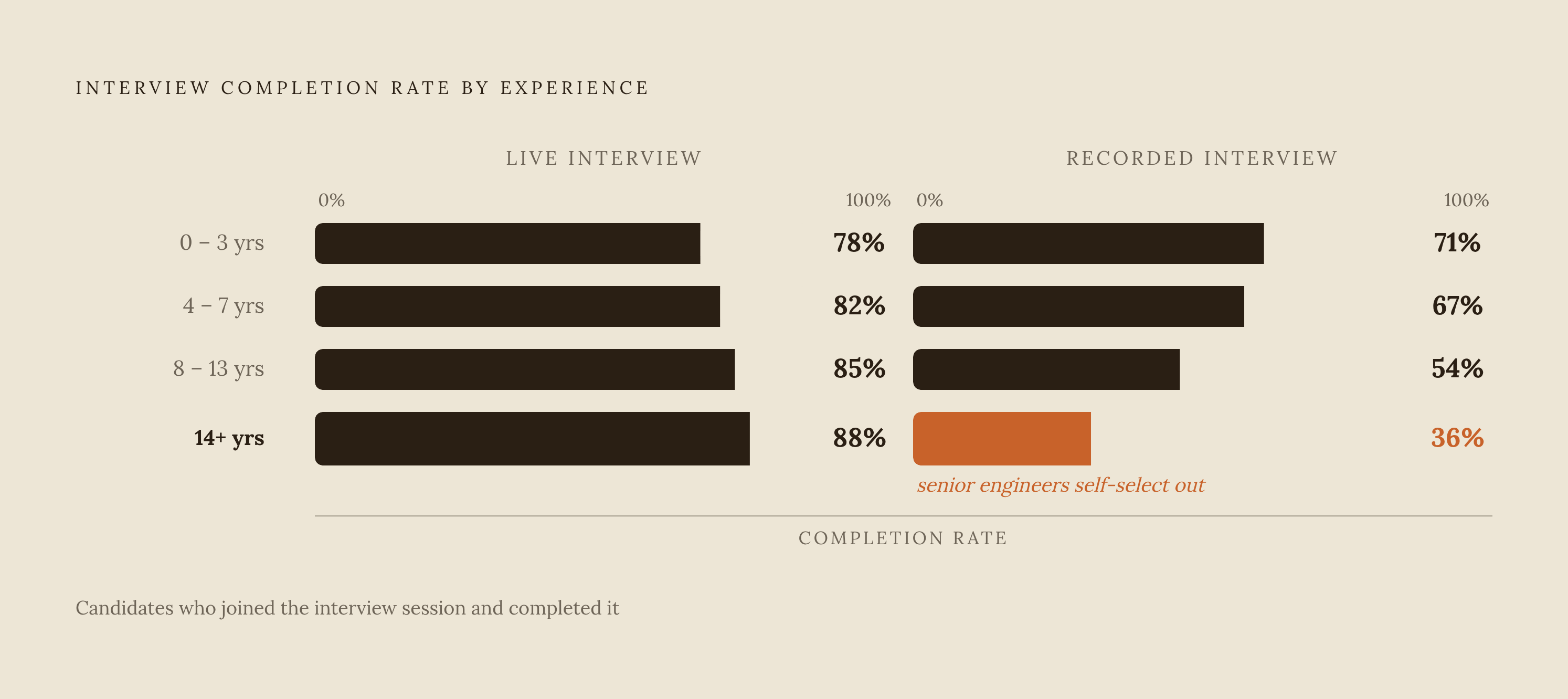
The people an AI startup most wants can leave a screen they judge to be low-signal, which changes the pool before the platform makes its final decisions. Engineers who have shipped LLM systems can recognize repeated questions, missing follow-up, and the absence of an appeal path. To them, a poorly designed automated interview can be a reason to close the tab.
Greenhouse’s 2026 Candidate AI Interview Report found that a significant share of US candidates had withdrawn from a hiring process because it included an AI interview, while others said they would. The experience gap is especially revealing. Among applicants with 14 or more years of experience, most joined the live interview, but only 36% finished the recorded one. That contrast challenges the idea that dropout simply reflects unwillingness to undergo assessment. Candidates can be willing to demonstrate their skills while rejecting the format used to judge them.
A rigorous, human-led process can send the opposite signal. It gives candidates a reason to believe that other engineers in the pool have met a meaningful standard. That credibility can attract people who care about the company they keep, while bad screening experiences can travel through Slack channels and conference dinners. Reputation compounds in a small professional community. For a startup evaluating a platform, candidate retention therefore belongs beside acceptance rate, because the two help distinguish deliberate filtering from the loss of strong applicants.
How offer-acceptance rates reveal whether a platform’s selectivity is real or performative
Offer-acceptance rate tests what happens after the filter. It measures the share of offers that matched candidates accept, rather than the share of applicants a platform admits. A platform can reject heavily and still introduce people whose preferences do not fit the roles. If those people repeatedly decline offers, the earlier selectivity has not translated into successful matching.
A strong offer-acceptance rate is evidence from the hires that follow that the platform understood what both sides wanted from the match. The candidate was not merely available for an introduction, but interested enough in the opportunity to join. That makes the measure a useful companion to rejection rate. The first describes the gate into the pool. The second helps show whether the people who get through are finding roles they actually want.
For buyers, the practical question is what share of matched candidates accept the offers they receive. Buyers also need to know how long the typical process takes from first introduction to signed offer. A platform that publishes only its acceptance rate leaves the outcome unresolved, while one that supplies downstream data makes its matching performance easier to judge. Missing data leaves a real gap in the case. A low admission rate cannot fill it, however hard the platform says it is to get in.
High rejection followed by frequent offer declines suggests that the filter or the matching may be miscalibrated. It may favor a narrow profile without understanding what those candidates want from a role. But when candidates often accept offers, the startup has a reason to trust the platform’s selectivity.
How the founding engineer bar differs from general senior hiring — and what that means for which platform to use
At a seed-stage AI startup, engineers need technical depth and must also be able to ship end-to-end, work without infrastructure support, and help shape the product. A research engineer at a lab or a senior engineer at a 500-person company may be excellent without fitting that combination.
Ownership is part of that distinction. A candidate can earn high technical scores and still be rejected because their account of past work does not show “founder-level accountability.” Founders are evaluating both how candidates describe responsibility and how well they solve technical problems. A platform that assesses only technical depth can miss that requirement. Its overall acceptance rate may make it look hard to get in while saying little about whether those who do are ready for a founding role.
A marketplace optimized for research-lab-pedigreed ML engineers may have rigorous sourcing and assessments aimed at a different kind of work from that of a seed startup building an LLM-powered product. For the startup, the relevant test is whether those assessments reveal the combination it needs. General selectivity cannot stand in for role-specific calibration.
Speed adds another constraint to that choice. Founding engineer interviews at seed startups usually take weeks from the first screen to the final decision. A platform that adds weeks of screening before an introduction can use up the window before a competing offer arrives. Its vetting may be real, but the candidate can still be lost. Selectivity and speed must work together, rather than force the startup to choose between weak evidence and a late introduction.
How should AI startups read a platform’s selectivity data before committing their hiring budget?
The first step is to request the acceptance rate and a description of every vetting stage. Those are different kinds of evidence. The percentage shows how restrictive the process is, while the stage descriptions show what the restrictions are designed to test. Live coding, a work sample or implementation challenge, and a direct test of AI tool fluency show what the process involves. For senior roles, a human in the final round is non-negotiable.
The next step is to ask for offer-acceptance rate and examine it with candidate retention. The distinction needs to stay explicit. One shows whether candidates who reach an offer want the job, while the other shows whether strong candidates stay engaged long enough to be assessed and matched. If a platform cannot or will not provide downstream data, the startup lacks evidence about the quality of its matches.
The startup should decide whether its opening calls for an AI engineer for applied LLM products, an ML engineer for model training and infrastructure, or a research engineer/scientist for novel methodology, a role that usually requires an advanced research degree. These are not interchangeable hiring tracks. The platform should be able to explain how its sourcing and vetting fit the chosen track, and provide examples of similar roles it has filled.
Speed completes the assessment. The startup should request the median time from first candidate introduction to offer stage, as well as how long those similar hires took. Curated invitation-based marketplaces can reduce dropout by matching and referring engineers. That approach can keep candidates in the process even when the bar is high, without slowing it down.