RAG Architecture Patterns for AI Startups
Start simple and climb the complexity ladder only when measured failures demand it.
RAG architecture for AI startups is a progression of patterns. The right pattern is the simplest one that solves a measured problem. Naive retrieval can quietly wreck answer quality, but premature sophistication can just as surely wreck cost, latency, and shipping speed. The engineering skill is knowing when to climb, when to stop, and when retrieval is the wrong approach altogether.
Why RAG has become the default infrastructure layer for AI startups building on top of LLMs
For most startups building AI features around private or changing information, the decision to use retrieval is effectively made. Foundation models have a knowledge cutoff, can fabricate answers without evidence, and make poor use of a prompt stuffed with an entire corpus. RAG separates knowledge from model weights so that updating information does not require retraining.
The payoff goes beyond fresher answers. Retrieved evidence gives a system the basis for citations and lets its answers be re-verified, which is especially important in regulated or trust-sensitive products. But attaching a database does not guarantee those qualities. The architecture controls whether the right evidence reaches the model, whether the answer stays within that evidence, and how much the process costs for each request.
The shift from "retrieve then generate" to a proper architecture discipline between 2023 and 2026
By 2026, pipelines had changed their defaults and improved their embeddings compared with 2023. Dense-only retrieval gave way to hybrid search, combining BM25 keyword search with dense vectors through Reciprocal Rank Fusion. Cross-encoder rerankers became a second relevance check on the top-k results. Each change addressed a gap in the earlier pipeline.
Raw questions could be rewritten, decomposed, or handled with HyDE when they did not express a clear retrieval target. When one search could not find enough evidence, multi-hop chains and agentic loops added more retrieval steps. These upgrades were warranted for products experiencing those failures. Teams needed to identify which failure the current system actually had.
Why the complexity ladder is the right mental model, and what "naive RAG" actually costs at startup scale
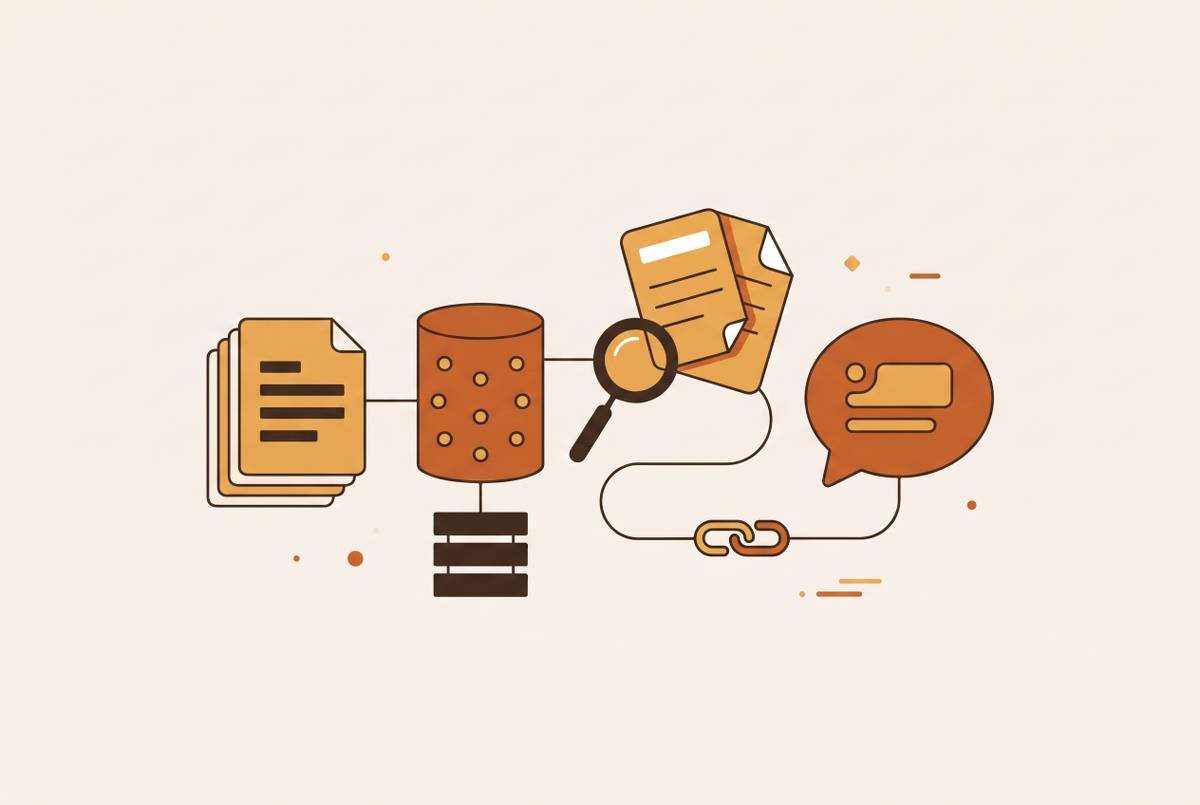
Naive RAG chunks documents, embeds them, stores the vectors, retrieves by similarity, and puts the results into a prompt. That is appropriate for clean factual lookups, FAQs, and MVPs. Its weakness is a silent miss, such as the eleventh real user question retrieving the wrong passage while the model supplies a plausible answer anyway.
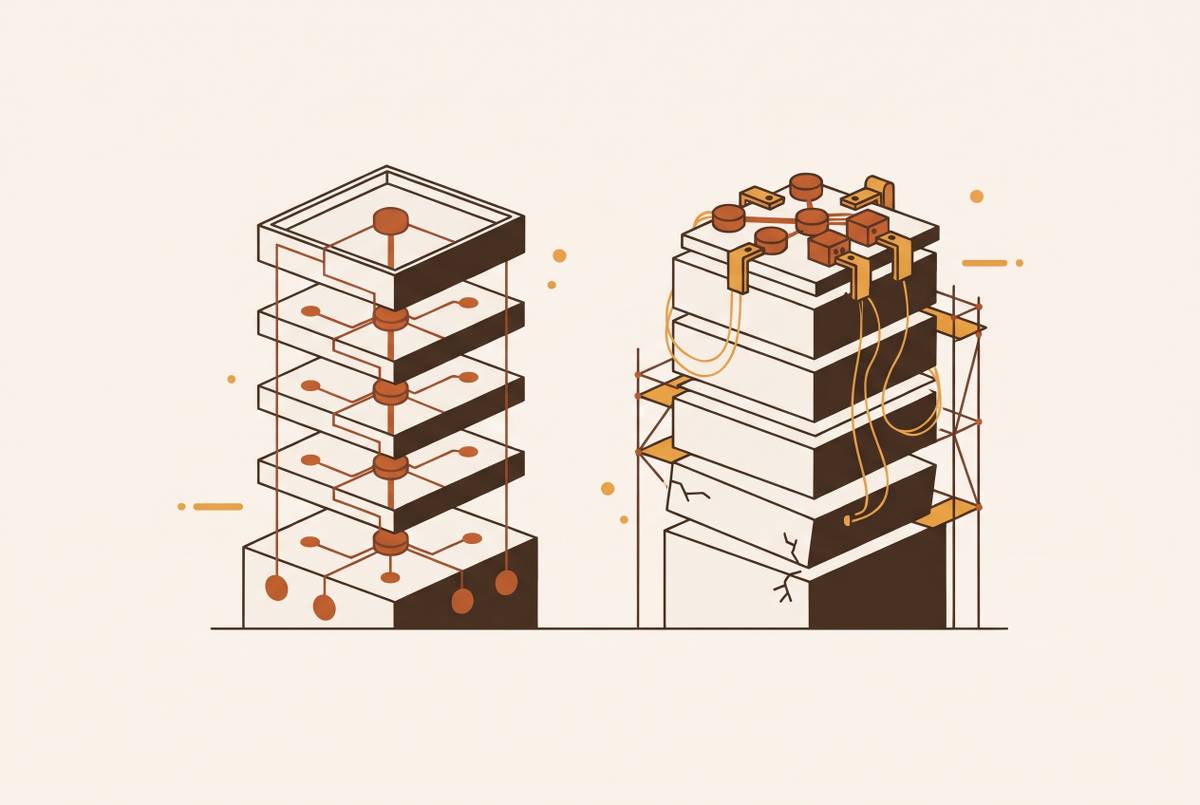
Premature sophistication creates the mirror failure. A stack of hybrid retrieval, reranking, query transformation, and agentic orchestration can double latency, multiply cost, and slow iteration on a product that needed none of it. More components do not prove production readiness. A weekend demo establishes little about retrieval reliability at p99, hallucination rates, traceable sources, or predictable per-query cost. The progression rule is therefore strict. A team should climb only to fix a failure it has measured.
Hybrid retrieval and reranking: the two cheapest upgrades that fix the majority of retrieval failures
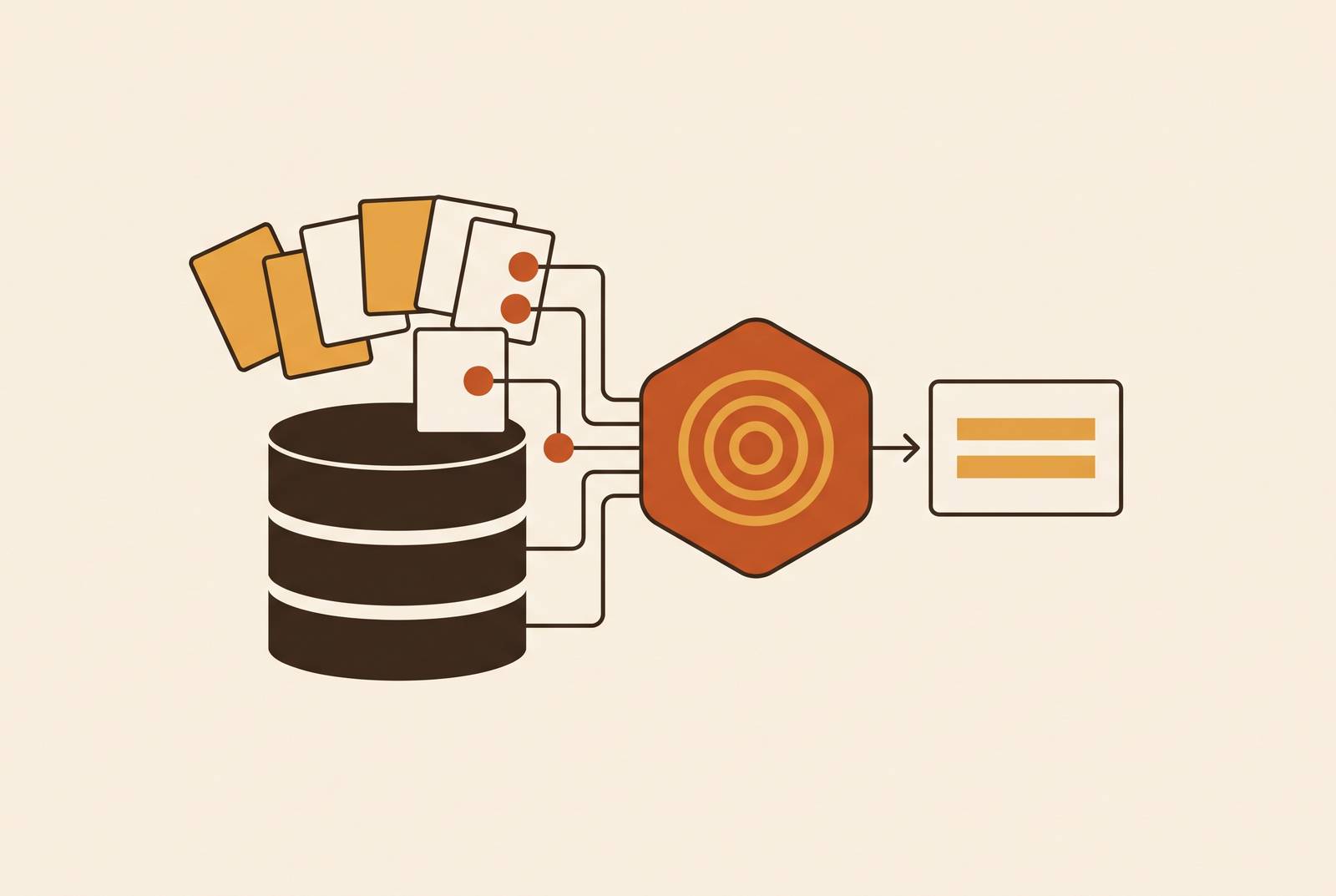
Hybrid retrieval and reranking are usually the highest-return improvements before anything exotic. Dense search finds semantic similarity, while BM25 finds exact words. Hybrid search joins those result lists through Reciprocal Rank Fusion so that both kinds of evidence can be included. Exact matches often win on enterprise data. With part numbers, error codes, proper nouns, and legal citations, fuzzy similarity can find something that is close but wrong.
Weaviate supports hybrid search natively, keeping the implementation burden low relative to the potential gain. Reranking addresses a different weakness after retrieval. A cross-encoder examines a broad candidate set and reorders it for relevance before the top few passages reach the model. That fixes cases where the right passage appears in the top twenty but not the top three.
Embedding model choice limits retrieval quality, and the MTEB leaderboard is a practical reference for current choices. Storage needs a separate justification. For teams below the scale of millions of vectors, pgvector inside an existing Postgres instance can be sufficient. A dedicated vector store is a decision about scale and filtering needs.
Query transformation and chunking strategy: the ingestion and pre-retrieval failures most teams diagnose too late
Many apparent retrieval failures begin upstream, in ingestion and query handling. A reranker cannot restore context that chunking removed. Oversized chunks drown useful evidence in irrelevant text, while undersized chunks separate an answer from the context needed to understand it. The 2026 default is a window in the low-hundreds to low-thousands of tokens with overlap, plus semantic re-chunking that respects section boundaries.
User questions create a second mismatch. A vague or compound question may not map cleanly to any single passage, even in a well-chunked corpus. Query transformation can rewrite it, split it into sub-queries, or use HyDE to generate a hypothetical answer for embedding. Those extra LLM calls cost time and money, so they earn their place only when the query distribution needs them.
A team should check chunking and query handling first, add transformation where it is needed, then tune hybrid retrieval and reranking once that base is sound. Otherwise, it can spend weeks ranking fragments that were broken during ingestion. Higher-level orchestration will not make that a good investment.
GraphRAG and agentic RAG: what these patterns actually cost and the narrow conditions under which they earn it
GraphRAG and agentic RAG solve problems that simpler pipelines cannot, but their operational costs demand a narrow justification. Microsoft open-sourced GraphRAG in July 2024 under MIT. It builds an entity-and-relationship graph and traverses it during retrieval, helping with global questions about connections or themes across a large corpus. Simple lookups get no corresponding quality gain. They get extra cost and latency.
The decision test is whether the answer requires relationships across documents that no single chunk contains. If a point lookup or hybrid search answers the question, a graph is the wrong tool. Agentic RAG earns its complexity by adding a retrieval loop when one retrieval pass cannot gather enough evidence.
Perplexity ships an agentic RAG product over the open web. Microsoft Copilot, formerly Bing Chat, and Google AI Overviews show large-scale RAG with reranking and citation surfaces. Those products establish that the patterns work, not that a three-person startup should copy them. Agentic systems also need durable, stateful orchestration, the use case behind LangGraph’s 1.0 milestone in October 2025. That adds more infrastructure to run and more governance work, so teams must measure the need before they adopt it.
Cache-Augmented Generation as a special case: when retrieval itself becomes the wrong abstraction
Cache-Augmented Generation sits outside the main ladder. It pre-loads the entire knowledge base into the LLM’s KV cache, replacing query-time passage retrieval. For a corpus that stays the same and has a fixed size, context-injection latency drops to near-zero.
Anthropic’s prompt caching makes that approach economically viable for the right document set. The approach costs too much when the corpus is large, changes often, or needs per-document access controls. A team whose knowledge base fits in the context window, changes infrequently, and needs no per-user access controls should evaluate CAG before building retrieval.
RAG versus fine-tuning: where the choice actually lives and why starting with RAG is the right default for most startups
RAG and fine-tuning do different jobs. Retrieval supplies private, current, or frequently changing knowledge, while fine-tuning changes behavior, output formats, or performance on a specialized task. The real choice concerns where knowledge should live and how behavior should be taught. Treating the two as substitutes obscures both decisions.
RAG must search, retrieve passages, and inject them into the prompt before generation begins, so voice assistants, real-time systems, and high-frequency bots may prefer a fine-tuned model’s lower-latency profile. Maintenance also differs. Prompt engineering needs the least upkeep, RAG needs indexes kept fresh and deletions handled, and fine-tuning needs labeled data and retraining from time to time as the data distribution changes.
The techniques can also work together. RAFT, or retrieval-augmented fine-tuning, trains a model to reason over retrieved documents within a domain while retaining retrieval’s freshness and auditability. But that does not make it the starting point. For most startups, the practical sequence is RAG first, followed by fine-tuning if real user data shows that the added investment solves a remaining behavioral problem.
Why evaluation is the layer most startup RAG systems skip and what it costs them in production
Even with a well-chosen architecture, failures can stay hidden until users find them if there is no evaluation. Retrieval quality asks whether the right chunk came back. Faithfulness asks whether the answer follows from the retrieved context, while groundedness asks whether every claim can be traced to a source. One accuracy score cannot tell these kinds of failure apart. Without that distinction, teams cannot tell which layer needs to be fixed.
RAG-specific evaluators for groundedness, context adherence, faithfulness, and answer relevance are now fast enough to run on every commit. The stronger system also turns production traces into evaluation datasets. Every failure becomes a test case, and every fix is tested against how people actually use the product. The test set grows where the product is weakest.
Enterprise deployments add a further requirement. Access controls, metadata, and data lineage must be part of the production design, because correct-looking answers can still create regulatory exposure when governance is missing. Evaluation alone cannot substitute for those controls.
The four anti-patterns that sink startup RAG systems before they reach production
Execution failures can sink any rung of the ladder. The first is chunk-size miscalibration, when real questions reveal problems with boundaries that looked harmless during ingestion. The second is using raw vector similarity without reranking, which can leave useful evidence among the candidates but out of the prompt. Both can produce fluent answers from inadequate context.
The third anti-pattern is having no evaluation harness. User satisfaction scores alone cannot separate retrieval errors from unsupported claims, so regressions remain hard to diagnose. The fourth is ignoring the latency budget. Stacking query transformation, hybrid retrieval, reranking, and agentic loops without measuring p99 latency can produce a technically correct system that is practically unusable. Each added component needs a latency justification.
Cross-source contradictions cut across these failures. Enterprise documents can disagree, and without faithfulness evaluation the model can synthesize that disagreement into a confident, wrong answer. To avoid these traps, teams should calibrate chunks against real queries, rerank where candidate ordering fails, maintain separate evaluation metrics, and budget latency before adding components. These are operating disciplines.
That discipline also defines the early hiring need. An AI engineer turns existing models into useful products, an ML engineer makes machine-learning systems reliable and scalable, and a research scientist creates or validates new methods. RAG-focused startups mostly need to make the parts work together in a product. Evidence that an engineer has shipped through real traffic, debugged chunking, or built an evaluation harness is therefore stronger than a credential proxy. Because the best engineers leave open hiring processes quickly, how long it takes to make a decision counts too. The scarce skill is not knowing the newest pattern’s name, but knowing whether the product needs it.