Recruiting Infrastructure for Engineers Who Are Not on the Market Yet
Passive engineers respond to relevant outreach and standing pipelines, not job posts.

Invitation-style recruiting finds engineers and gives them a reason to talk before asking them to apply. Fonzi uses a curated matching model for this need, with interview requests that include salary bids upfront. But reaching engineers who are not on the market takes more than a platform or a better job post. It requires relationships, a standing pipeline, and a hiring process built before the vacancy appears.
Why most engineering roles cannot be filled by waiting for applications
Most skilled engineers in AI and software are not on the market at any given moment. Hiring only through inbound applications reaches a small share of engineers, where many companies compete for the same people. A better job description can help a company compete within that group, but it cannot reach people who never open it.
The competition also changes depending on how an engineer enters the conversation. Active candidates apply to many roles simultaneously, so an inbound applicant may already be comparing several companies. A company reaching a passive engineer may be the only recruiter in that person’s inbox. The engineer still has a job and needs a concrete reason to consider leaving it.
Waiting for applications leaves both conditions untouched. Passive sourcing is therefore not an optional tactic for an unusually difficult search.
What passive engineers actually look like and what moves them
Passive does not mean unwilling to move. Most passive candidates are not searching but could be receptive to a specific opportunity. Super-passive engineers are further from deciding to move and need a different approach. Treating both groups as ready applicants mistakes permission to talk for an intention to leave.
The reasons to move are usually concrete. An engineer may want harder technical problems, a more interesting stack, or more ownership over what gets built. Another may want less bureaucracy, less technical debt, or a clearer connection between their work and its impact. These are different motivations, even when the engineers have similar experience. A pitch about scope will not necessarily reach someone whose main frustration is the work itself.
Perks and vague claims about culture do little to fix those frustrations. Buzzword-heavy descriptions are worse when they suggest the sender has not read the engineer’s work. The opportunity has to answer a personal question. What would become possible in this role that is not possible in the current one?
For an AI-native founding engineer role, the target becomes more specific. A senior engineer from a Series A or B company with exits or significant growth behind them already knows what zero-to-one building costs. They may want to do it again, but on their terms. The lesson for outreach is straightforward. The right message depends on understanding what this person wants to change.
Where passive engineers are actually findable before they go on the market
Engineers who are not on job boards still leave traces of their work. GitHub contribution history, Stack Overflow answers, and Discord or Slack communities around particular stacks show expertise in use. These traces provide more than names for a search. They give a recruiter something specific to learn about before reaching out.
Technical writing offers another way into that work. Personal blogs, developer-focused platforms, and documentation contributions reveal where an engineer invests effort and attention. Conference speaker lists and attendee communities can also help with senior or niche searches. Speakers and panelists are especially approachable just after an event, when their work supplies a natural subject for conversation.
The events themselves need to fit the search. The AI Council, formerly Data Council, takes place May 12–14 in San Francisco and is vendor-neutral and practitioner-built, with hands-on technical content and no sponsor-driven sessions. KubeCon + CloudNativeCon NA takes place November 9–12 in Salt Lake City, with content covering GPU scheduling, model serving, security, and more. These are concrete places to encounter the work. Their technical focus gives a team a reason to take part beyond finding people it might hire.
For NYC-based sourcing, AI Engineers Tech Talks runs monthly, with past hosts including Harmonic, Instacart, Hebbia, and Noemica. Comma Deeptech Meetup focuses on robotics and physical AI, while AI Tinkerers NYC offers builder-focused evenings. Employee referrals give a team a head start because people already trust each other. The practical recommendation is to ask employees for named individuals rather than general leads, and to revisit the question regularly.
A controls systems engineer may fit an electrical role, just as an AI engineer may fit an ML systems role. Skills and outcomes make a better search boundary than titles alone. Otherwise, a team can participate in the right communities and still overlook the right person.
Why personalized outreach at small volume beats mass messaging at scale
Finding someone’s work is only useful if the first message reflects it. Generic mass outreach gets response rates in the low single digits, while messages tailored to a smaller group can get far more replies. The number of messages delivered tells a team little about whether people have begun talking about a possible move.
Passive engineers already get many messages from recruiters, and many of them see those messages as copy-pasted or AI-generated. A credible message has to overcome that expectation. It names something the engineer actually did, connects the opportunity to a plausible next step, and opens with a low-commitment question. Salary range, tech stack, and work model belong upfront because they help engineers decide whether to talk.
Researching a handful of people carefully takes much more effort per message than sending a template, and many recruiting teams cannot sustain that workload across every search. AI-assisted tools can accelerate research, but they can also produce recognizable boilerplate. A person still needs to judge whether the role is a good fit for the engineer.
Personalization is not simply inserting the name of a project into a standard pitch. It requires understanding why the work suggests a fit and whether the opportunity offers something the person might want.
Follow-up needs the same restraint as first contact. A second message three to five days after the first is the recommended timing, with outreach stopping after two attempts to protect sender reputation. When someone declines, asking whether a future check-in is acceptable keeps the decision with them. Outreach begins to become a pipeline through contact with people who are not ready this quarter but may be open next quarter.
Building a standing pipeline rather than sourcing from scratch each time a role opens
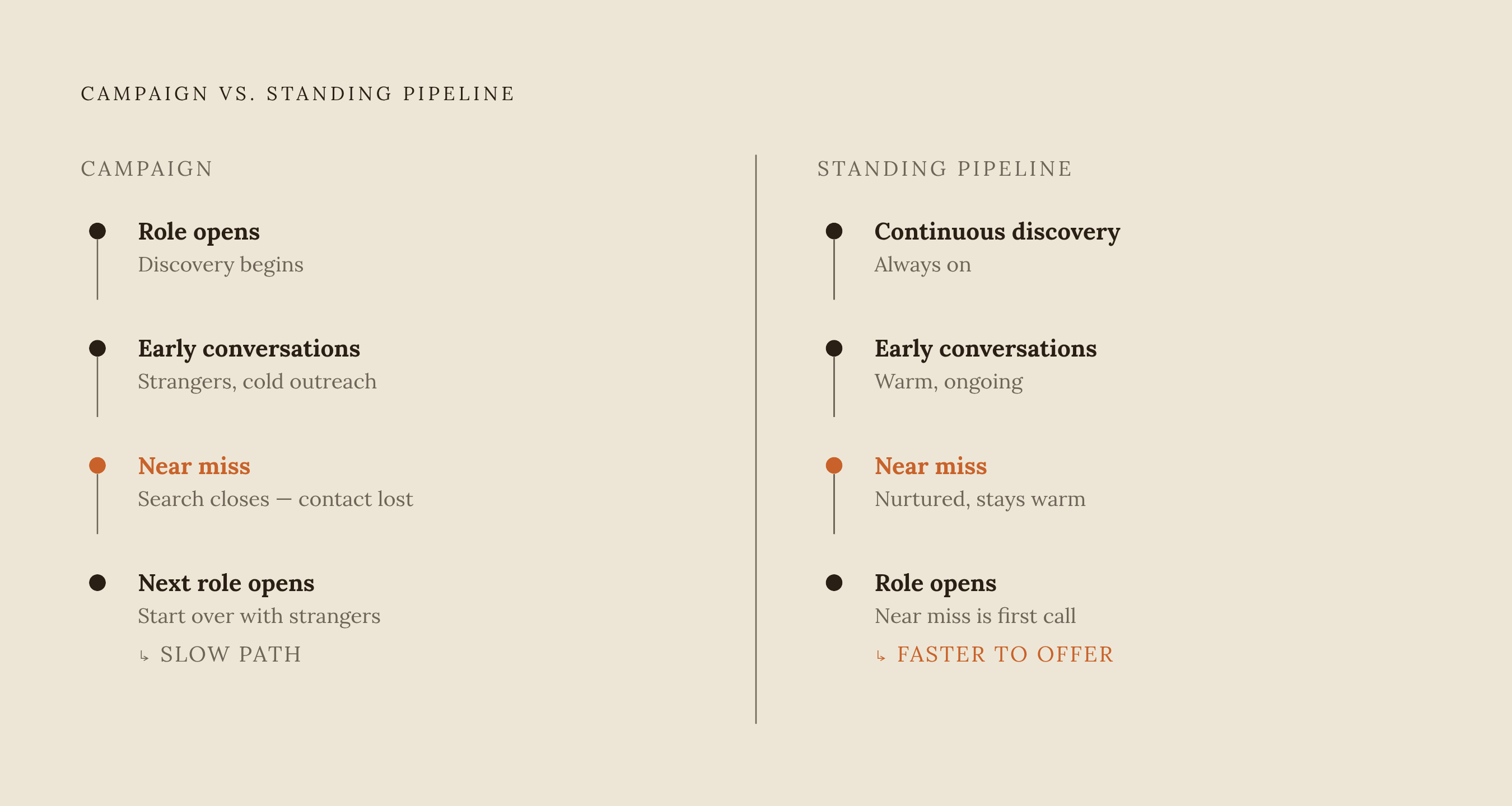
Campaign recruiting starts with a vacancy and then tries to create access, trust, and urgency at once. A standing pipeline separates that work from the immediate hiring deadline. It is a proactively sourced and nurtured collection of qualified people for current or future needs. Discovery and early conversations happen even when there is no role to close.
That changes what happens to a promising conversation that does not produce a hire. In a campaign, someone who is interested but not ready can become a dead end once the search finishes. In a standing pipeline, that person is a “near miss” whose timing may fit a later opening. Follow-up becomes a continuing workflow rather than something a recruiter remembers when another vacancy appears. The relationship has value beyond the current requisition.
This is how the personalization workload becomes more useful over time. Research is still required, and a warm list does not eliminate the need to assess fit for a particular role. But each opening need not begin with a new set of strangers. Past conversations help a team understand whether someone is interested, what they want, and when they might move.
Speed becomes decisive when a role opens. Engineering finalists often have several offers at once, and they become less likely to accept as the days pass. A pre-built warm list compresses the path to an accepted offer because discovery and early relationship work have already happened. It gives the company a chance to act before another process gets there first.
Maintaining that capability requires time, familiarity with the workflow, and consistent nurturing. In-house HR teams cannot always do all three while filling roles that are open now. The organizational choice is therefore whether to build the capability internally or work with a specialized partner. Either way, the commitment must survive the end of an individual search.
What the interview and offer process must look like once a passive engineer enters the funnel
An engineer who agrees to talk has not necessarily agreed to become a candidate. They may only be testing whether the opportunity deserves more attention. A slow or opaque process can destroy the trust that made the conversation possible. Sourcing and interviewing cannot be designed as separate systems. The promise made in outreach has to hold once the engineer enters the process.
Compensation is part of that promise. An employed engineer considering a move expects market rate or a premium, and early disclosure of salary and equity helps them judge whether the opportunity is serious. Leading with a range is a signal of respect. It also gives both sides a basis for deciding whether to continue.
The time the process asks of engineers needs just as much care because passive engineers already have jobs. Multi-day take-homes and redundant screening rounds consume time before the company has earned much commitment. The emerging format in 2026 is the trial PR, in which a candidate opens an IDE, takes a real ticket, and ships a working patch with an AI coding tool in the loop. Interviewers look at candidates’ prompt-as-spec discipline, verification habits, and how well they judge AI-generated code when reviewing it.
Work model is another early filter. AI engineering roles have more remote and hybrid availability than research scientist roles, which skew heavily onsite. For a team searching nationally, an onsite-only requirement sharply narrows the pool and raises the standard for what the in-person environment must offer. Leaving that constraint vague postpones a decision the engineer needs to make.
How Fonzi is built for engineers who are not looking
A curated talent marketplace for software and ML engineers can put matching rather than application volume at the center of its model. Such a model reaches engineers who code outside work and have strong views about how an engineering organization should run. The intended fit is specific. It serves AI startups and high-growth tech companies that need to reach engineers who are not browsing job boards.
The model reverses much of the usual search flow. Engineers are found and referred, while companies send interview requests rather than waiting for applications to individual vacancies. That does not mean there is no entry step. The platform describes candidates applying once and then choosing which requests to accept, each with a salary attached upfront.
An AI talent agent, available through iMessage or a web app, handles screening and matching before delivering those requests. Engineers can therefore judge a concrete opportunity. This addresses a specific weakness in passive outreach without requiring them to commit to a full interview process first.
The marketplace serves three groups that fit the broader sourcing argument. They include ex-startup or big-tech engineers open to returning to startups, cracked juniors with a high bar of public work, and engineers at startups who are quietly open to the next one. Data shows that the best candidates leave open processes within weeks, so the design emphasizes shorter time-to-decision.
The company also runs events in SF and NYC where engineers who code for fun gather, creating opportunities for relationships before roles open. That community work fits the same model as the matching product. Neither starts with the assumption that the right engineer will see a vacancy and apply.