Library and Public Wifi Spots in SF Suitable for Remote Engineering Work
Where to work remotely in SF's public libraries, and why location matters more than you'd expect.
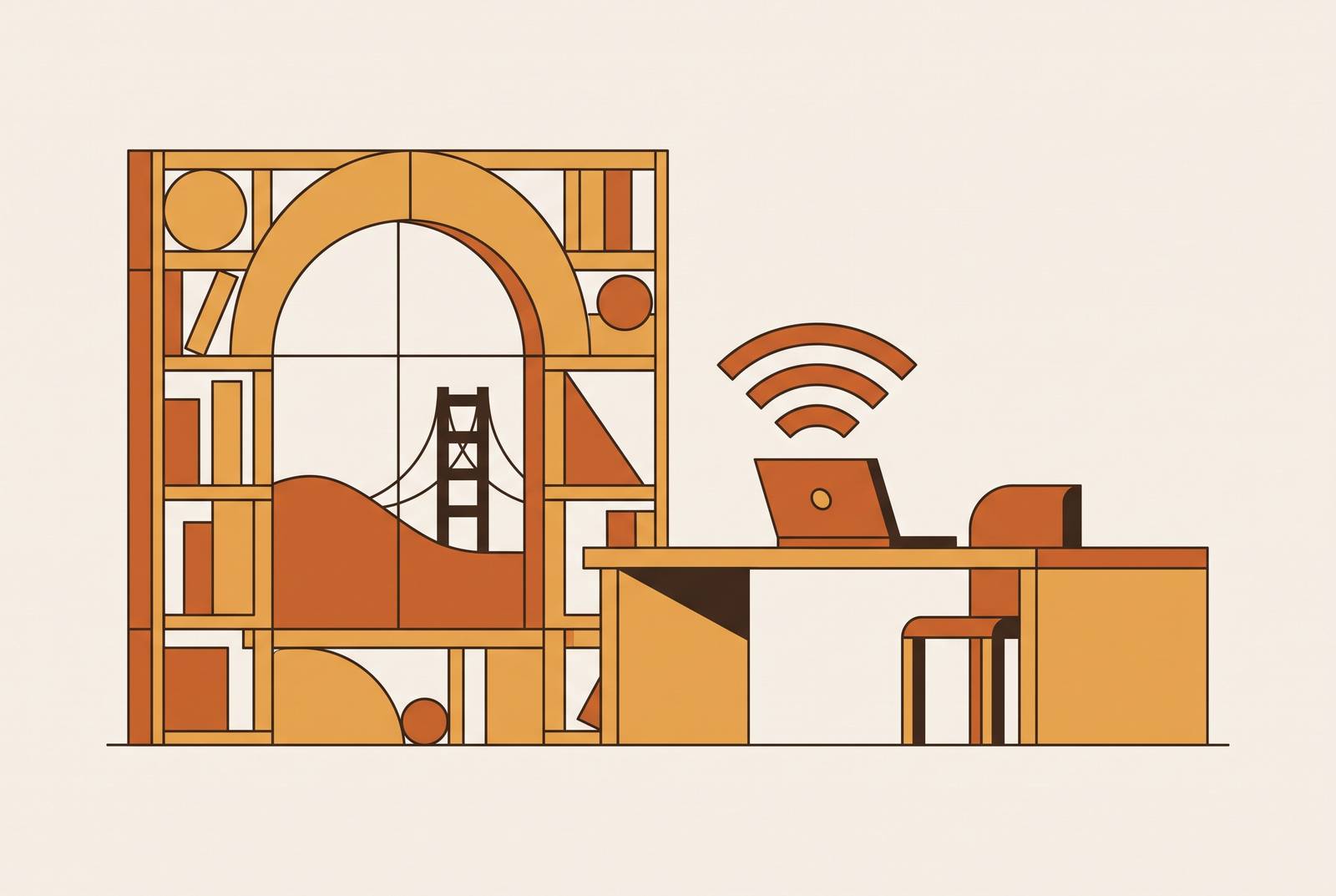
San Francisco’s public libraries and selected public WiFi spots are practical places for remote engineering work. The best choice depends on the job that day. SFPL offers serious connection capacity, power, and quiet workspaces, but a good coding desk is not automatically a good interview room.
Why SF's public library network functions as real engineering infrastructure
A remote workspace has two layers, namely the connection and the physical space around it. SFPL’s fiber backbone gives the first layer real capacity. The FCC’s current broadband benchmark sets one threshold for download and another for upload. Upload speed is more likely to fall short during video calls, screen shares, and cloud file syncing.
The physical layer makes that connection useful for more than a quick stop. Most branches have plenty of outlets, free WiFi on all floors, and computers and printers to use. Those are many of the same amenities a coworking space charges for. But shared infrastructure still has a shared-load problem, and peak-hour headroom determines how much capacity remains available as demand rises. The fiber backbone is therefore the key variable.
What actually separates an engineering-suitable spot from a place that just has WiFi
The useful decision matrix has three axes, which are connection stability, noise control, and power. Their weight changes with the work. Pair programming, interview screen shares, and cloud compute access put pressure on upload and latency. Solo coding can work well in open seating, while a live system design interview needs a space with more control over sound. For that call, an enclosed room is a functional requirement.
Power is less dramatic but just as practical. An outlet near the seat supports a long session, while hunting for one interrupts it. Certain SFPL branches also have glass-enclosed study rooms with a table, chairs, outlets, and WiFi, but access is first-come, first-served and sessions are typically limited to two hours. That means a branch can score well for connectivity and power yet remain uncertain for a scheduled call. How close a branch is can break a tie once it meets those needs.
Main Library (100 Larkin St, Civic Center) — the highest-bandwidth, most resource-dense option
The Main Library sets the network’s ceiling with a 10 Gigabit connection and six floors of workspace. WiFi reaches every floor, and there are plenty of outlets at study tables and carrels. That combination gives it the strongest infrastructure case for sustained engineering work. The connection has enough headroom to keep busy floors usable, though WiFi sometimes drops during peak after-school hours. Backbone capacity and a dependable individual wireless connection are related, but they are not the same thing.
The fourth floor is the recommended working floor for its natural light and spacious desks. The fifth-floor reading room offers a quieter, skylight-lit alternative. For engineers between roles, the fourth floor also puts useful career resources close to the desk. The Business, Science and Technology Center reference desk has information on jobs and careers, while the Jobs & Careers Center has study tables and WiFi in a round, wood-paneled room. SFPL describes that room as a place for individual use rather than meetings, preserving its quiet setting.
Civic Center has direct BART and Muni Metro connections, so this is the easiest branch in the network to reach by transit. The tradeoff is the surroundings, which can feel uncomfortable. Security is present but adds some friction, and the chairs are not the most ergonomic choice for marathon sessions. Private study rooms are available on a first-come, first-served basis, while larger meeting rooms can be reserved online through SFPL. This is the strongest infrastructure option.
Richmond / Senator Milton Marks Branch (9th Ave, Inner Richmond) — the most comfortable all-day branch
Richmond trades the Main Library’s wealth of resources for a more comfortable place to work for hours. Its two bright, open floors have consistent WiFi, comfortable seating, and plentiful outlets. That makes it easier to work for hours without hunting for power or dealing with the discomfort of the Main Library’s neighborhood. Food on Clement Street also makes it easy to step out for a meal and keep the day on track.
The branch has two private, glass-enclosed study rooms and a separate meeting room. That makes it a strong candidate for days that mix solo work with calls, subject to room availability. Richmond is the all-day comfort pick, but its study rooms still operate under the system’s first-come rules.
Mission Bay Branch (4th St) — best proximity to the AI and biotech corridor
Mission Bay’s distinguishing asset is its position near the UCSF/biotech corridor and South of Market. For engineers with meetings or events in that part of the city, the location shortens the trip. AI teams cluster in SoMa and Mission Bay, making this branch a natural base for a day spent near that ecosystem. Its value is the adjacency between a place to concentrate and the places the rest of the day may require.
The workspace fits that role, with a modern building, bright natural light, and a quiet spot by the river. There are plenty of outlets, free WiFi, and several study rooms to meet the main needs of people working on laptops. People traveling light can also borrow a laptop to use in the library. Mission Bay’s quieter setting makes it a good choice for solo work in place of the Main Library, though its connection may not match the hub’s capacity. As elsewhere, the presence of study rooms does not guarantee one at the hour of a call.
Four neighborhood branches worth knowing — Ortega, Eureka Valley, Potrero, and Glen Park
Ortega Branch at 3223 Ortega St in the Outer Sunset offers ocean views, natural light, free laptops, and WiFi, with one study room and one meeting room limiting its private-space options. Eureka Valley / Harvey Milk Memorial Branch at 1 Jose Sarria Ct in the Castro has a working fireplace, comfortable seating, free WiFi, and plentiful outlets for long solo sessions, but it is the only SFPL branch that cuts off WiFi after hours. Potrero Branch at 1616 20th St in Potrero Hill is bright and quiet, with big windows and city views, though limited seating makes early arrival important for all-day work. With food and coffee on 18th Street, it is easy to take a break there. Glen Park Branch at 2825 Diamond St is light-filled, with free WiFi and plentiful outlets, and its quieter weekday mornings make it better suited to morning deep-work blocks than all-day camping.
The study-room constraint and how to work around it
Private study rooms are the biggest planning constraint in the SFPL system. They cannot be reserved in advance, and users must sign in in person at the location. Sessions are typically capped at two hours because these rooms serve a broad pool of library users. A branch having a room is therefore different from a room being available when a technical interview starts. Treat access as a bonus unless there is time to arrive substantially early.
Enclosure also has limits. The rooms contain normal conversation volume but are not fully soundproof, so loud adjacent noise can bleed through. That may be fine for an ordinary call, but confidential system design discussions or offer negotiations may need more privacy. For those days, consider a paid space with phone booths. The distinction is between getting some separation from the room outside and having the privacy the conversation requires.
For planned calls, SFPL’s larger meeting rooms can be reserved up to 90 days in advance at no cost. At the Main Library, high-demand rooms should be requested as early as possible through the online system. Neighborhood branch meeting rooms are typically available on a walk-in basis, so they do not offer the same planning certainty. A reserved Main Library meeting room is the clearer solution when the calendar is fixed.
Public non-library spots that round out the map — Salesforce Park, the LinkedIn POPOS, Sightglass Coffee, and Beluna Cafe
Salesforce Park has free public WiFi and tables among plants for work outdoors. Its place in the tech district makes it useful for ambient work between meetings. It is a different setting from a quiet library desk.
The LinkedIn building atrium at 222 2nd Street is an indoor public space. It is a Privately Owned Public Open Space, or POPOS, with free access, long tables, and abundant seating. Floor-to-ceiling windows and walls covered in modern art distinguish the room from a conventional work floor. Its proximity to the SoMa startup cluster makes it useful for the same between-meetings role as Salesforce Park. The details given leave open whether there is private call space and what the measured upload rate is.
Beluna Cafe near the Panhandle has more of the practical equipment needed for an extended work session. It offers abundant plugs and seating, fast WiFi, a printer, and a second-floor mezzanine. Noise ranges from a low buzz to quiet, giving it a stronger work-hub profile than a coffee shop with only a connection and a spare chair. That still does not establish enclosed call space. Sightglass Coffee is also named among the options, but the available information gives no practical details about its power, connection, hours, or call suitability, so it cannot receive the same specific recommendation.
Choosing the right spot by what you're actually doing that day
For a scheduled technical interview or offer call, the choice turns on room access. Arrive early at Richmond or Mission Bay for a study room, or reserve a Main Library meeting room when certainty matters. A free desk and a suitable private conversation space are separate decisions.
For deep solo coding with the most connection headroom, choose the Main Library’s fourth floor. Mission Bay is the alternative when a quieter, modern setting fits the day better. For an all-day session without a specific call, Richmond is the comfort choice. Glen Park and Potrero work well for days spent in the neighborhood, especially when their available morning seats fit the work schedule.
For outdoor or ambient work between meetings in the SoMa tech district, choose Salesforce Park or the indoor LinkedIn POPOS. For evening work, avoid counting on Eureka Valley / Harvey Milk after hours, and choose the Main Library or a SoMa cafe while they are open. San Francisco offers a spread of working infrastructure that can keep an engineer productive while physically close to the teams, meetings, and opportunities that make being in the city worthwhile.